

Review
There are movies that feel like stories, and then there are movies that feel like curses. This is one of the latter. Watching it feels like opening an old book you were warned not to touch and realizing too late that the warnings weren’t exaggerated. It doesn’t move fast, it doesn’t dazzle you with spectacle, and it doesn’t rely on cheap shocks. Instead, it builds this crushing, inescapable atmosphere that sinks into you like damp air in a cellar. It’s gothic horror in the purest sense—slow, heavy, and unrelenting.
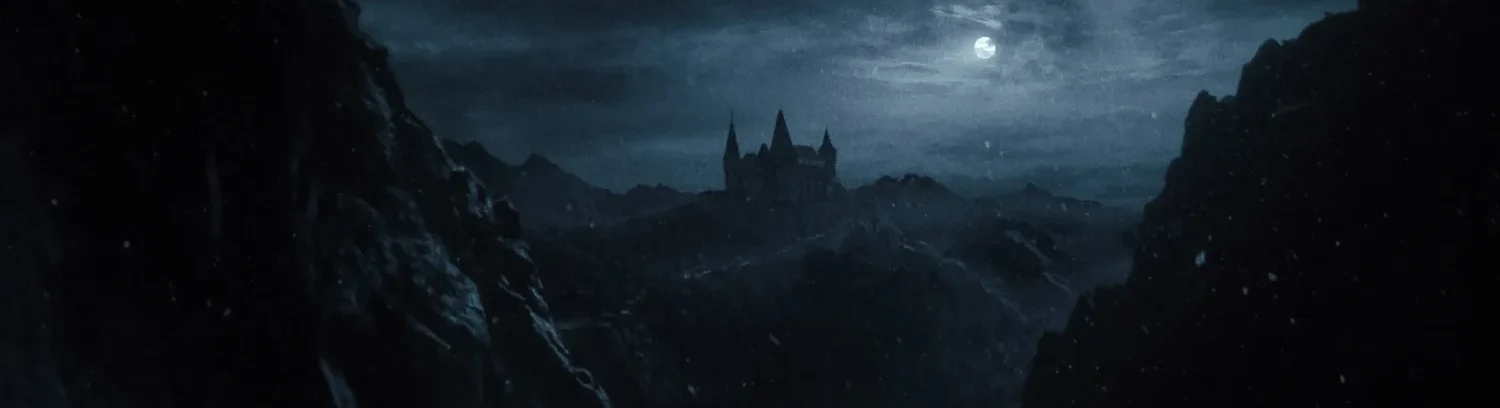
The visuals are immediately what pull you under. Every frame is crafted with the precision of a painting, but not the kind you’d hang on your wall. These are images that repel as much as they attract, beautiful but unsettling, like staring too long at something you know you shouldn’t. Shadows don’t just fall naturally—they stretch, distort, twist into shapes that feel alive. Candlelight flickers in a way that doesn’t comfort but instead highlights the emptiness beyond its reach. You’re constantly aware of what you can’t see, and that’s where the real terror lives.
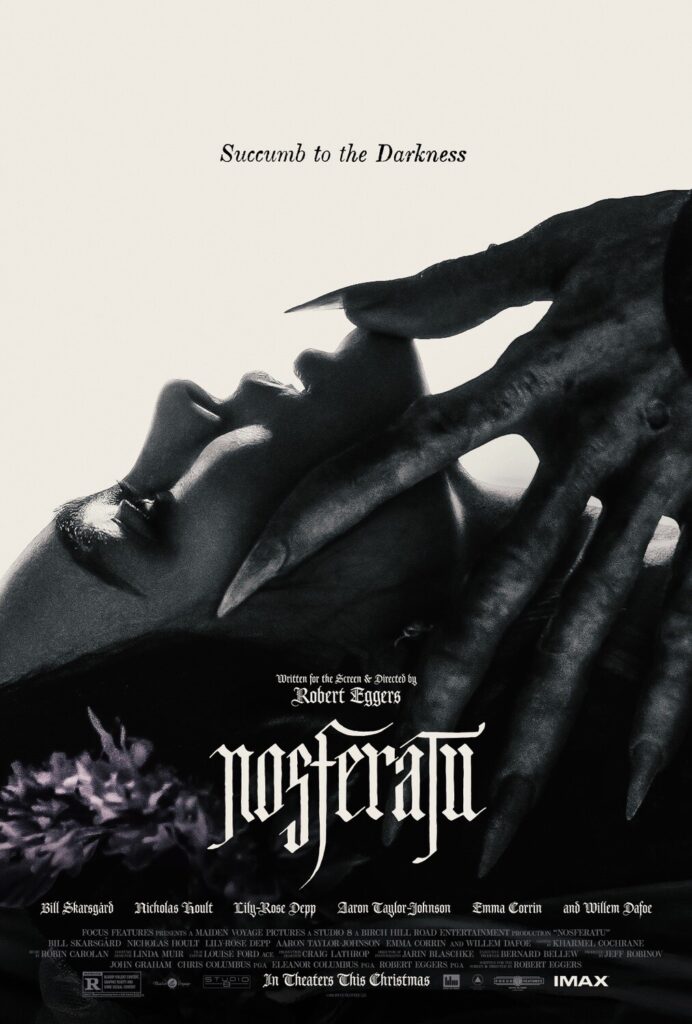
The performances give the imagery its weight. Nicholas Hoult is excellent as the kind of man who unravels in silence, his sanity peeling away one thin layer at a time. You can practically watch his body cave in under the pressure of what he’s seen. Lily-Rose Depp brings this fragile, almost otherworldly presence to her role, the kind of performance where the character feels less like a person and more like a ghost who hasn’t realized she’s already gone. And then there’s Skarsgård as Nosferatu—something genuinely monstrous. Not the romanticized vampire we’ve been fed by decades of pop culture, not even the tragic, brooding figure you might expect in a modern gothic. He’s revolting. Every movement feels unnatural, every glance curdled with malice. He doesn’t just drink blood—he contaminates every space he enters.
What makes the film truly effective, though, isn’t the monster himself. It’s the dread that surrounds him. The film understands that horror isn’t about what you see but about what you know is coming. Long silences stretch out until they’re unbearable. Footsteps echo in empty corridors, and you’re certain something is there even when the frame insists it isn’t. It’s that anticipation, that certainty of doom, that makes the experience suffocating. You’re not just watching a story unfold—you’re waiting for the inevitable, and the inevitability is worse than anything sudden.
Some people will call it slow. Some will call it pretentious. And honestly, if you’re looking for rollercoaster pacing or jump scares every few minutes, you’re going to be disappointed. But that’s not the point. This isn’t horror built for adrenaline. It’s horror built for corrosion—for the way dread eats away at you over time until you realize you’re trapped in it. The slowness is the design. It’s the weight pressing down, the centuries of rot settling over every character and every location.
The film also deserves credit for refusing to compromise. It doesn’t wink at the audience, doesn’t modernize the myth to make it more palatable. It plays the material straight, almost archaically straight, and that commitment gives it its power. You don’t feel like you’re watching a contemporary update of a classic. You feel like you’re watching something dug up, something that was always there, waiting. That’s a rare kind of confidence in filmmaking—to trust that the audience will come to it rather than watering it down to meet modern expectations.
By the time it ends, you’re not left with catharsis or relief. You’re left with a kind of heaviness, like you’ve been carrying someone else’s nightmare for two hours and now it’s yours to keep. It’s bleak, it’s relentless, and it’s exactly what it needs to be. For me, that kind of total commitment earns nothing less than a perfect 5/5.
Leave a Reply